Tech book must reads
There are few things that match listening to the narrative of smart people. Here is a list of books that made a huge difference to how I think.
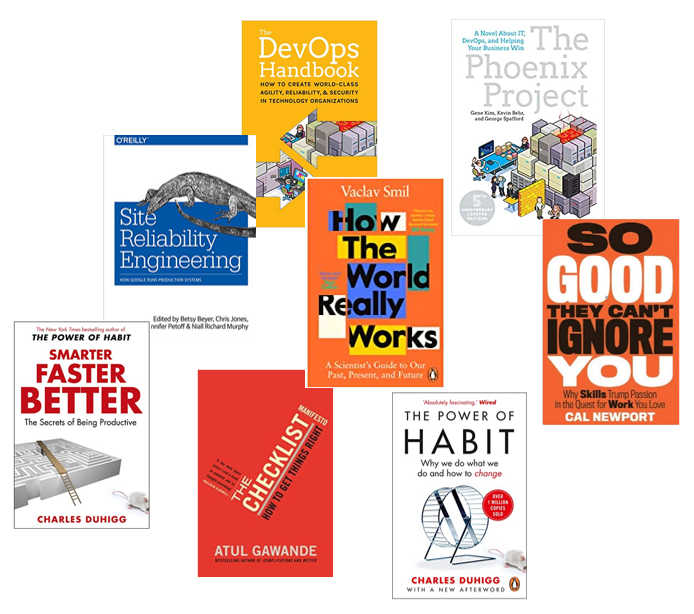
Site Reliability Engineering: How Google Runs Production Systems
Niall Richard Murphy, Betsy Beyer, Chris Jones
Why read this: The first few chapters should be taught as a 101 for anyone entering the industry. Possibly one of the most important reads for those involved with running production systems.
The Phoenix Project: A Novel about IT, DevOps, and Helping Your Business Win
Gene Kim, Kevin Behr, George Spafford
Why read this: Its characters are frequent players in IT. While it’s a huge buzz to be the hero who resuscitates a critical service during an outage, the enterprise needs an engineering mindset and not ego.
The DevOps Handbook: How to Create World-Class Agility, Reliability, and Security in Technology Organizations
Gene Kim, Kevin Behr, George Spafford
Why read this: The follow-on to ‘The Phoenix Project’, it elaborates on the ‘three ways’: Flow, Feedback and Continuous Improvement, and explains how lean manufacturing principles apply to the technology value stream. There is so much in this book, It should be standard text for all in technology.
Cloud FinOps
JR Storment & Mike Fuller
Why read this: This sets out the roadmap for adopting and maturing FinOps discipline, is required reading for FinOps Certification, more importantly it exposes why cloud costs are higher than typically than forcast. Fundamental reading for anyone responsable for estimating the cost of cloud.
The ROI Story
Steven Kaplan
Why read this: This is for anyone involved in understanding the cost of IT infrastructure. Maybe it is best to read this before Cloud FinOps as they complement each other. This is important reading as your career develops and understanding how to talk to management about cost becomes important.
So Good They Can’t Ignore You
Cal Newport
Why read this: Probably one of the most important books to read when at a career crossroads, A mix of scientific research and real-life examples, illustrating how successful individuals have achieved their status by honing their craft and becoming indispensable in their fields, it delves into the importance of deliberate practice, the 10,000-hour rule, and the need for a craftsman mindset, prioritizing skill development over immediate gratification.
How the World Really Works
Vaclav Smil
Why read this: Bill Gates said the first three chapters should be required reading for anyone who wants to have an informed opinion on climate change. Understanding the energy dependency of industries such as food production, manufacturing, and transportation is a first step for anyone interested in sustainability.
Principles: Life and Work
Ray Dalio
Why read this: Invaluable insights into decision-making and success, practical frameworks for both personal and professional growth, making it a must-read for anyone looking to navigate challenges with clarity and purpose, there is huge insight into the way we think about what we want from our work life.
Outliers
Malcolm Gladwell
Why read this: Explores the hidden factors behind success. This is the book that introduces the “10,000-Hour Rule,” how achieving expertise in any skill largely depends on practicing the correct way for approximately 10,000 hours. That practice, combined with opportunities and timing, play a crucial role in being successsfull.
Blink
Malcolm Gladwell
Why read this: The book provides fascinating insights into the science of decision-making and the subconscious processes that shape our choices, how our brains, through years of practice and exposure, develop an intuitive sense, and the potential pitfalls of snap judgments.
The Power of Habit
Charles Duhigg
Why read this: This isn’t a technology book, but helps understanding the science of habits, and how to unlock your potential by making positive changes more achievable. Between the neuroscience are great anecdotes that make it one of the best and most enjoyable books I’ve read.
Smarter Faster Better: The Secrets of Being Productive
Charles Duhigg
Why read this: Duhigg uses great storytelling, along with scientific research and real-world examples, to illustrate the key concepts that drive productivity: emphasizing that productivity isn’t about working harder or longer, but about making smarter choices and adopting effective habits.
How Big Things Get Done
Bent Flybjerg & Dan Gardner
Why read this: Explains why so many large projects run massively over budget and are delivered late. It discusses the dangers of over-optimism and short-term politics, and emphasizes the importance of thorough planning, risk management, and leveraging experience to achieve goals.
The Checklist Manifesto: How To Get Things Right
Atul Gawande
Why read this: Because humans are a leading cause of outages, especially when environments are complex and many steps are needed to do something. This book convinced me of what I already suspected. It’s not just about writing down the steps of a process, but thinking it through and developing a collaborative culture that makes individual specialists put ego aside and work together.
The Chimp Paradox
Steve Peters
Why read this: Because it doesn’t matter how much you know about technology, if you don’t understand and control your emotions and have difficulty working with others, you won’t have a great time at work.